

Yes, parts of a settlement agreement are taxable, and no, the whole sum is rarely tax-free. Genuine termination compensation can qualify for the £30,000 exemption, but earnings elements like unpaid salary, holiday pay, bonuses, and PILON are always taxed as income. Payments tied to injury or illness can escape tax entirely if properly evidenced. Before signing anything, check exactly how your settlement figure has been split, because that split is what HMRC will look at first.
TL;DR
- The first £30,000 of genuine termination compensation is tax-free, but unpaid salary, holiday pay, bonuses, and PILON are always taxed as earnings.
- Payments for injury, illness, or disability related to employment can be entirely tax-free without any cap if properly evidenced.
- The actual allocation of settlement sums between earnings and non-earnings determines tax liability, making detailed itemisation essential before signing.
- A lump sum that combines multiple payments without breakdowns increases the risk of HMRC reclassifying parts as earnings, raising taxes and National Insurance.
- Settlement payments can affect benefits like Universal Credit, with large sums potentially reducing or suspending entitlement based on total available capital.
Settlement agreement tax: which payments count as earnings
Not every pound in a settlement gets the favourable treatment reserved for termination compensation. Some elements are simply your normal pay, dressed up in a different envelope, and HMRC treats them exactly as it would a payslip.
The following are taxed as earnings and go through PAYE regardless of how the settlement agreement describes them:
- Unpaid wages or salary owed up to the termination date
- Accrued but untaken holiday pay
- Contractual or discretionary bonuses due under your employment
- Payment in lieu of notice (PILON), assessed under the post-employment notice pay (PENP) rules
- Sums paid for restrictive covenants, where these are genuinely taxed as employment income
Your employer operates PAYE and Class 1 National Insurance on these amounts before the money reaches your account, exactly as HMRC’s guidance on termination payments sets out. A typical settlement might include some unpaid holiday, payment in lieu of notice, and an amount described as compensation for loss of employment. The first two elements are taxed as earnings on payslip day. The third is where the £30,000 exemption potentially comes into play, and where most of the negotiation actually happens. Employers must also allocate marginal items correctly to the right earnings period, a responsibility set out in HMRC’s employer guide to PAYE and National Insurance.
The £30,000 exemption explained
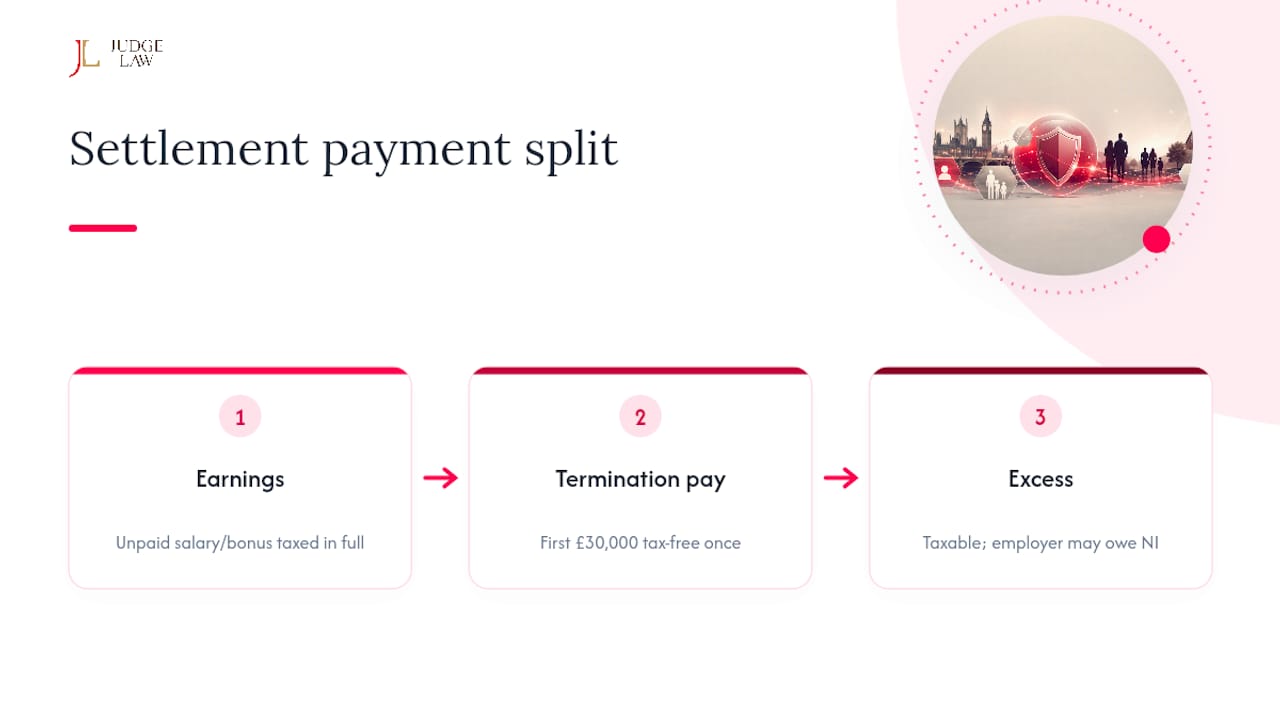
The first £30,000 of a genuine termination payment is generally exempt from income tax, a rule that sits at the heart of most settlement negotiations. Anything above that threshold is taxable, and your employer may owe Class 1A National Insurance on the excess.
£30,000 is the statutory tax-free ceiling for qualifying termination payments under current HMRC rules. This exemption only applies to genuine compensation for loss of employment, never to earnings.
Take a settlement worth a total amount. If part of that is unpaid salary and bonus, that portion is taxed as earnings in full. Of the remaining termination compensation, the first £30,000 is tax-free and any excess is taxable, with the employer potentially liable for Class 1A National Insurance on that excess. The exemption applies once, across all qualifying termination payments from that employment, not £30,000 per payment or per agreement.
Injury, illness and disability payments
Compensation paid because an injury, illness or disability prevents you from continuing in your job can be entirely tax-free, with no £30,000 cap, provided the payment genuinely relates to the medical condition rather than simply hurt feelings or a general grievance., provided the payment genuinely relates to the medical condition rather than simply hurt feelings or a general grievance.
HMRC expects a factual and medical link between the payment and the condition. That typically means occupational health reports, GP or specialist letters, or documented evidence showing that the injury or illness prevents you from carrying out your job. A settlement that simply labels a sum “injury payment” without any supporting medical evidence is unlikely to survive scrutiny, and HMRC’s own guidance on termination payments makes clear the unlimited exemption depends on that genuine connection, not the wording chosen by either side’s solicitor.
Why the wording in your agreement matters less than the substance
HMRC does not simply read the label on a payment and accept it. Internal guidance confirms that the substance of a payment overrides how it is described: if a sum is really contractual pay, or really a fee for a restrictive covenant, it gets taxed as earnings whatever the settlement calls it.
This becomes particularly important when one lump sum is meant to cover several different things at once. Where an agreement fails to break a payment down clearly, HMRC will make its own reasonable apportionment based on the facts, and that reallocation can increase your tax bill considerably. Common drafting pitfalls include:
- An undivided lump sum with no breakdown between salary, notice, and compensation
- Vague phrases like “compensation for loss of office” applied to money that is really unpaid bonus
- Repayment or clawback clauses that suggest the payment was conditional pay, not a clean break
- Confidentiality or restrictive covenant sums bundled into the “compensation” figure without separate identification
Payments made for restrictive undertakings, such as non-compete or confidentiality promises, are taxed in full as earnings, so treat any such labelling in your agreement with real caution.
Pro Tip: Ask your solicitor to insert a short, itemised schedule into the settlement agreement rather than relying on a single descriptive paragraph. A numbered breakdown is far harder for HMRC to challenge than a sentence of prose.
A checklist for negotiating apportionment before you sign
Getting the drafting right at the negotiation stage is far cheaper than fighting HMRC afterwards. Work through these steps with whoever is advising you:
- Request a clear, itemised schedule allocating sums to salary, holiday pay, redundancy, injury to feelings, legal fees, and any restrictive covenant payment separately.
- Ask your employer to pay your legal fees directly to your solicitor where appropriate, rather than folding them into the headline figure.
- Document the factual basis for any injury or illness related sum with medical evidence, occupational health reports, or correspondence that predates the settlement.
- Gather payroll history, email correspondence, and any tribunal pleadings that support how the figures were reached.
- Get combined legal and tax advice before signing, and keep a signed copy of the final agreement along with all supporting paperwork.
Pro Tip: If part of your dispute involves notice pay or garden leave, check how those weeks are treated before agreeing a final figure. Our guide to garden leave and notice pay explains how these periods interact with PENP calculations.
What happens if HMRC queries your settlement
HMRC enquiries into settlement payments tend to focus on exactly the issues covered above: apportionment, evidence, and whether a label matches the substance of the payment. If HMRC decides a sum was really earnings, it can raise additional tax and National Insurance, sometimes with interest, and the enquiry can drag on for months while records are requested.
The most useful thing you can do immediately is preserve every document connected to the settlement: correspondence, medical evidence, and the schedule of payments. Speak to a solicitor and a tax adviser together rather than separately, since the legal characterisation of a payment and its tax treatment are decided by the same facts. Depending on how the agreement was drafted, exposure can sit with the employer, the employee, or both, and it may be necessary to bring the former employer’s payroll team back into the conversation to clarify what was actually paid and why.
Reporting a settlement payment on your self-assessment return
Most settlement payments taxed through PAYE are already accounted for by the time they reach your bank account, but that does not mean your self-assessment obligations disappear automatically. If you are already required to file a return, whether because you are self-employed, a higher earner, or have other untaxed income, any taxable element of your settlement that was not correctly taxed at source needs to be declared.
The practical steps are straightforward. First, get a P45 or a final payslip from your employer showing exactly what was taxed and when. Second, check whether the termination payment exceeded the £30,000 exemption, and if the excess was not fully taxed through payroll, include that shortfall as employment income on your return. Third, keep the settlement agreement itself, along with any schedule of payments, as supporting evidence in case HMRC later asks questions. If you are not already within self-assessment and your only income was employment income taxed correctly through PAYE, you generally will not need to file a return purely because of the settlement. Where doubt exists about whether an amount was taxed correctly, raising it proactively with HMRC or your accountant tends to cause fewer problems than waiting for a compliance check to find it first.
Does a settlement affect your benefits or entitlements?
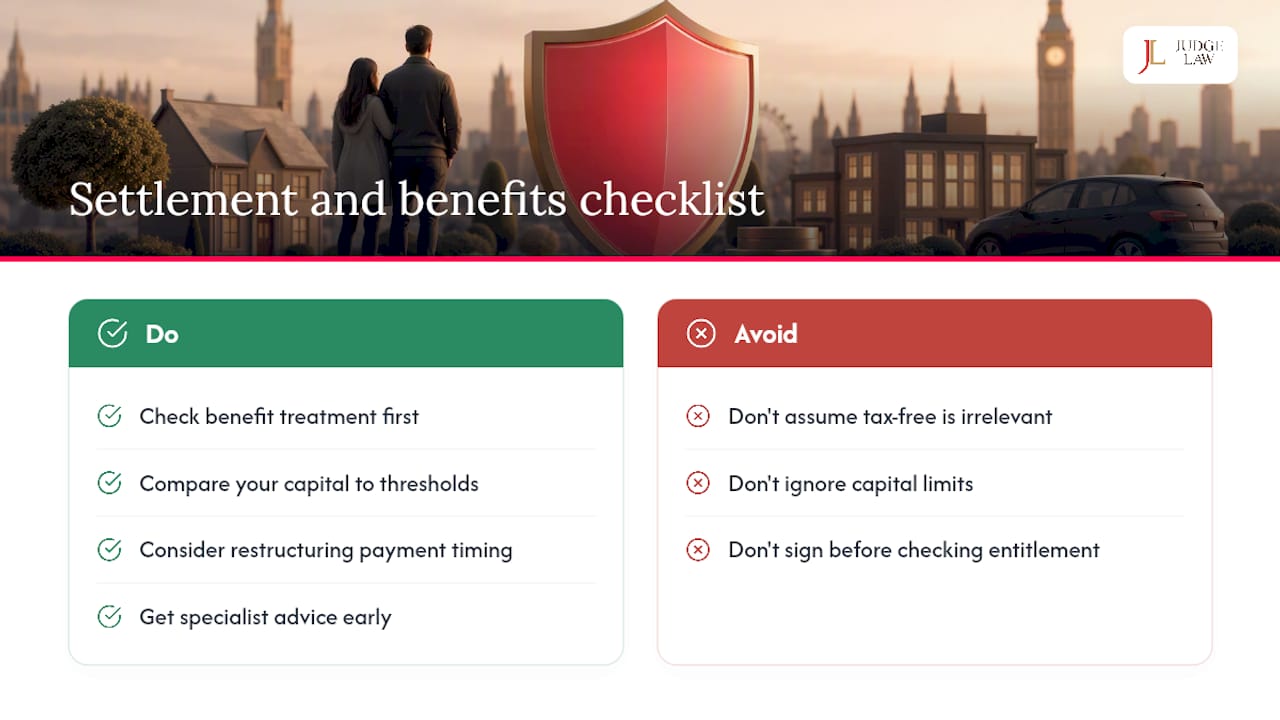
A settlement payment can affect means-tested benefits, and this is one of the most overlooked consequences of accepting a lump sum. Universal Credit and other means-tested benefits take capital and certain types of income into account, so a large settlement sitting in your bank account can reduce or temporarily stop entitlement even though the money itself was compensation for losing your job.
Capital limits matter here. If your total savings, including the settlement money, push you above the relevant threshold for the benefit in question, your entitlement can be reduced or suspended until your capital falls back below that level. Redundancy pay and termination compensation are generally treated as capital rather than income once received, which changes how they are assessed compared to ongoing earnings. This is a separate question from whether the payment is taxable, and it catches people out because they assume a tax-free termination payment is also invisible to the benefits system. It is not. If you are receiving or expecting to claim means-tested support, it is worth checking the specific treatment of your settlement figure before you sign, since restructuring the timing or the elements of a payment can sometimes soften the impact on entitlement.
Why the standard advice on settlement tax undersells the negotiation stage
Most guidance on settlement agreement tax treats the £30,000 exemption as a fact to be reported rather than a figure to be negotiated. That undersells what actually happens in practice. The exemption is not automatically applied to whatever number appears in the agreement; it is applied to whatever HMRC decides the payment genuinely represents once it looks past the label.
The gap between what employees expect and what they receive usually traces back to one thing: a settlement that lumped several payments together without a proper breakdown. Conventional advice tends to focus on whether you are entitled to the exemption at all, when the sharper question is whether your agreement is drafted well enough to stand up to HMRC’s substance-over-label approach if it is ever tested.
If there is one priority worth considering before you sign anything, it is this. Push for an itemised schedule, insist on evidence for any injury-related element, and treat the drafting stage as the moment that determines your actual tax bill, not a formality that happens after the real negotiation is done.
Frequently asked questions
Do you pay tax on a settlement agreement in the UK?
Often yes, in part. Earnings elements like unpaid salary, holiday pay, and PILON are always taxable, while genuine termination compensation can be tax-free up to £30,000.
How much tax will I pay on my settlement?
It depends on how the payment is split. Earnings elements are taxed at your normal income tax and National Insurance rates, and any termination compensation above £30,000 is taxable, with employer Class 1A National Insurance potentially due on that excess.
Do I have to pay tax on a divorce settlement in the UK?
Divorce settlements are governed by different rules to employment settlement agreements and are generally not subject to income tax in the same way, though transfers of certain assets can carry other tax considerations. This article covers employment settlement agreements specifically, so speak to a family law solicitor about your divorce settlement’s particular tax position.
What is an HMRC PAYE settlement agreement?
A PAYE settlement agreement is a separate arrangement that lets employers settle the tax on certain minor or irregular staff expenses and benefits in one payment, rather than payroll a settlement compensation payment for an individual leaving employment. It is not the same thing as an employment settlement agreement negotiated between an employer and a departing employee.