

The Renters’ Rights Act 2025 is tenant protection legislation that abolishes no-fault evictions, converts all assured shorthold tenancies to periodic tenancies, and introduces rent increase controls across the private rented sector in England. If you are one of the 11 million private renters affected by these changes, understanding exactly what the law now gives you matters. It is the foundation of every decision you make about your home. The Ministry of Housing, Communities and Local Government and Shelter England have both published guidance on the Act, but the practical detail of what it means for your tenancy, your rent, and your right to stay in your home is what this guide sets out to explain.
TL;DR
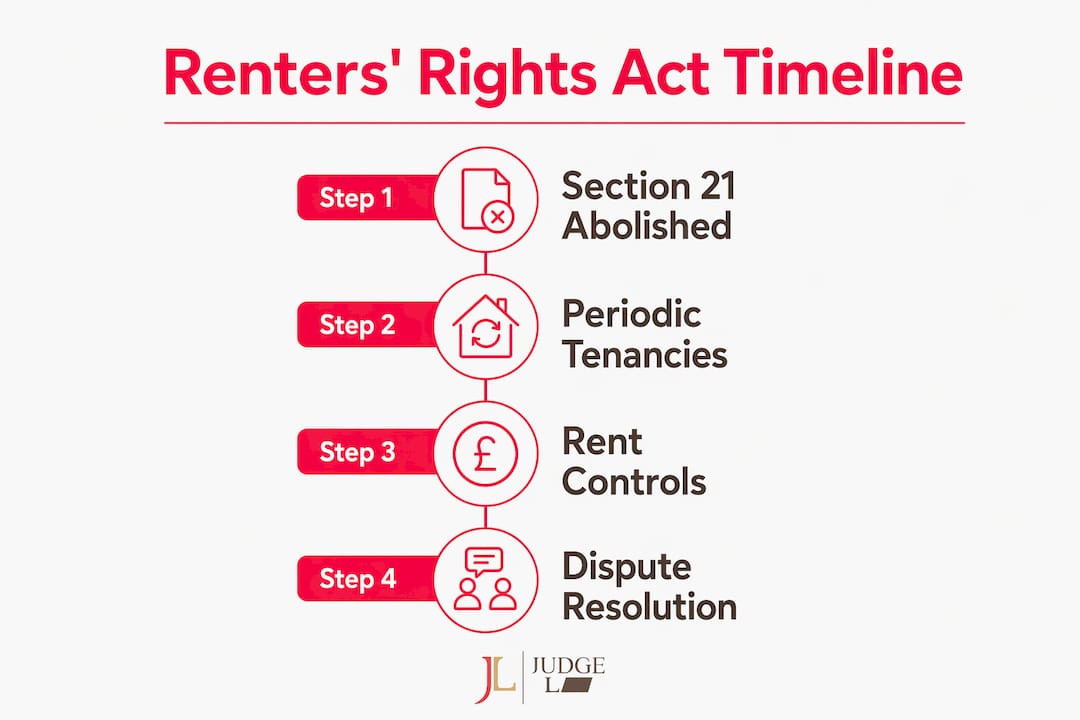
- From 1 May 2026, section 21 no-fault evictions ended and existing assured shorthold tenancies became rolling assured periodic tenancies automatically.
- To regain possession, a landlord must rely on a Section 8 ground, and a notice that cites no ground is not enforceable.
- Rent can rise only once every 12 months through a formal Section 13 notice, and you can challenge an increase at the First-tier Tribunal.
- Rent bidding is banned, and landlords cannot refuse you because you receive benefits or have children.
- The landlord database and the Landlord Ombudsman arrive in later phases of the roll-out.
What does the Renters’ Rights Act mean for your tenancy?
The most immediate change under the Renters’ Rights Act is the conversion of tenancy types. Existing assured shorthold tenancies automatically converted to assured periodic tenancies on 1 May 2026. You did not need to sign a new contract or take any action. The conversion happened by operation of law.
An assured periodic tenancy runs on a rolling basis, typically month to month. There is no fixed end date, which means your landlord cannot simply wait for a contract to expire and ask you to leave. You now have continuous security of tenure unless your landlord can establish a valid legal ground for possession.
What changes for you in practice?
- No fixed-term end dates. Your tenancy continues indefinitely until you choose to leave or your landlord obtains a valid possession order.
- Two months’ notice to leave. If you want to end your tenancy, you must give two months’ written notice aligned with your rent period.
- Government Information Sheet. Landlords were required to provide all existing tenants with an official government Information Sheet by 31 May 2026. This document summarises your new rights. If you did not receive one, your landlord or letting agent may face a fine.
- No new contract required. Your existing tenancy terms carry over. The protections apply to you automatically.
Pro Tip: Keep a copy of any Information Sheet your landlord provides. If a dispute arises later about what you were told and when, that document is evidence.
The shift to periodic tenancies is significant. It removes the anxiety of approaching fixed-term end dates, when many tenants historically felt pressured to accept rent increases or poor conditions simply to avoid the disruption of moving.
How do the new eviction rules protect you from 1 May 2026?
Section 21 of the Housing Act 1988 is abolished. From 1 May 2026, no-fault evictions are unlawful. A landlord cannot serve you notice simply because they want their property back, without giving a legally recognised reason.

To regain possession, your landlord must now rely on amended Section 8 grounds. These grounds are either mandatory, meaning the court must grant possession if the ground is proved, or discretionary, meaning the court weighs up the circumstances. Section 8 statutory grounds include situations such as the landlord needing to sell the property, the landlord or a close family member needing to move in, or serious rent arrears.
If you receive an eviction notice, follow these steps before doing anything else:
- Check the notice type. A valid notice must reference a specific Section 8 ground. Any notice that does not cite a ground is not legally enforceable.
- Check the notice period. Different grounds carry different required notice periods. Shorter notice periods apply to serious rent arrears; longer periods apply to grounds such as the landlord wishing to sell.
- Do not ignore the notice. Even an invalid notice can become a problem if you miss court deadlines. Seek legal advice promptly.
- Verify the ground applies. If your landlord claims they need the property to sell or move in, there are conditions attached. For example, they cannot re-let the property within a set period after using those grounds.
- Contact your local council. Local councils now hold civil penalty powers up to £40,000 for landlords who attempt illegal evictions. Reporting a suspected unlawful eviction to your council is a legitimate and protected step.
Pro Tip: If you are unsure whether a notice you have received is valid, do not assume it is. Read our guide on illegal eviction and tenant rights before responding.
The abolition of Section 21 is the most significant change for tenant security in a generation. Tenants facing eviction should verify every notice carefully, because only specified Section 8 grounds now carry legal weight.
What are the new rent controls and payment rules?
Rent increases and upfront payment demands are now tightly regulated. The rules are straightforward, and the penalties for landlords who breach them are real.
| Rule | What it means for you |
|---|---|
| Maximum advance rent | Your landlord cannot request more than one month’s rent in advance |
| Frequency of increases | Rent can only rise once every 12 months |
| Notice requirement | Increases must be served via a formal Section 13 notice |
| Rent bidding | Landlords cannot accept or solicit offers above the advertised rent |
| Civil penalty for breach | Up to £7,000 for breaches such as rent bidding or asking for more than one month’s rent in advance, rising to £40,000 for repeat or continuing breaches |
The Ministry of Housing, Communities and Local Government has set out the once-a-year limit on rent increases in its own guidance for landlords.
The ban on rent bidding is particularly important. Before this legislation, some landlords in high-demand areas were effectively running informal auctions, accepting the highest offer from competing tenants. That practice is now unlawful.
If you believe a rent increase is unreasonable, you have a direct route to challenge it. Tenants can refer an increase to the First-tier Tribunal, which will assess whether the proposed rent reflects the open market rate. The Tribunal’s role is to ensure increases are fair, not to freeze rents indefinitely.
Key points to remember about rent challenges:
- You must apply to the First-tier Tribunal before the new rent takes effect.
- The Tribunal can set a rent at or below what your landlord proposed, but not higher, so there is less risk in applying than under the old rules.
- Your landlord cannot retaliate against you for using this process. Any attempt to evict you in response would need to meet the Section 8 grounds test.
Are landlords banned from discriminating against you?
Yes. Discrimination against tenants on the basis of benefits receipt or the presence of children in the household is now illegal under the Renters’ Rights Act. This is a meaningful shift. Previously, blanket “no DSS” policies, where landlords refused to consider anyone receiving housing benefit or Universal Credit, existed in a legal grey area. That grey area is gone.
The anti-discrimination provisions mean:
- A landlord cannot refuse your application solely because you receive housing benefit, Universal Credit, or any other state benefit.
- A landlord cannot refuse to rent to you because you have children.
- If you believe you have been refused a tenancy on either of these grounds, you have stronger legal footing to challenge that decision than at any previous point in English housing law.
On pets, the Act gives you the right to request permission to keep a pet. Your landlord must reasonably consider your request and cannot refuse without a justifiable reason. They cannot make consent conditional on you taking out pet damage insurance, but a blanket refusal without engagement is no longer acceptable. These provisions contribute to a fairer renting experience, particularly for families and those in long-term housing need.
What comes next? The phased roll-out of the Act
Not every element of the Renters’ Rights Act came into force on 1 May 2026. The phased implementation means further protections and enforcement tools are being introduced in later stages.
| Phase | Timing | Key changes |
|---|---|---|
| Phase 1 | 1 May 2026 | Section 21 abolished, periodic tenancies, rent controls, anti-discrimination rules |
| Phase 2 | From late 2026 | Private Rented Sector Database rolled out region by region; Landlord Ombudsman to follow (landlord membership expected in 2028) |
| Phase 3 | 2027 onward | Full enforcement integration, expanded dispute resolution |
The national landlord registry is significant for tenants. Once operational, it will allow you to check whether your landlord is registered and compliant. An unregistered landlord faces penalties, and the registry creates a public record of enforcement action.
The Landlord Ombudsman will provide a free dispute resolution service for tenants and landlords. Before this body exists, your primary routes for disputes remain the First-tier Tribunal for rent matters, the county court for possession proceedings, and your local council for enforcement. Plan your approach based on what is available now, and watch for the Phase 2 announcements.
What these changes mean for tenants in practice
The Renters’ Rights Act is the most substantive reform to English tenancy law in decades. But legislation on paper and protection in practice are two different things.
The tenants who struggle most are often not those who lack rights. They are those who do not know their rights exist, or who hesitate to assert them because they fear the consequences. That fear was rational under the old Section 21 regime. A landlord could serve a no-fault notice in response to any complaint. That deterrent is now gone.
The practical advice for any tenant is this. Document everything. Every communication with your landlord, every maintenance request, every rent payment, every notice you receive. If a dispute arises, the tenant who has a clear paper trail is in a fundamentally stronger position than one who is relying on memory.
The phased roll-out also means you should not wait for Phase 2 or Phase 3 protections before acting on a problem. The core rights, including the Section 21 ban, the Section 8 grounds requirement, and the rent increase rules, are live now. If your landlord is behaving as though the old rules still apply, that is worth taking seriously and addressing promptly.
What these laws may ultimately shape is a rental culture in England where longer tenancies become the norm, where landlords invest in properties they expect to manage for years rather than flip, and where tenants feel secure enough to report problems without fear. That outcome depends on tenants knowing and using the rights they now hold.
Frequently asked questions
When did the Renters’ Rights Act come into force?
The core provisions of the Renters’ Rights Act came into force on 1 May 2026, including the abolition of Section 21 no-fault evictions and the conversion of assured shorthold tenancies to periodic tenancies.
Do I need to sign a new tenancy agreement to get the new protections?
No. Existing assured shorthold tenancies converted automatically to assured periodic tenancies on 1 May 2026 without any action required from tenants.
Can my landlord still evict me under the new rules?
Yes, but only using valid Section 8 grounds, such as serious rent arrears or the landlord needing to sell or move into the property. A notice that does not cite a recognised ground is not legally enforceable.
How often can my landlord raise my rent?
Rent can only increase once every 12 months and must be served via a formal Section 13 notice. You can challenge any increase you consider unreasonable at the First-tier Tribunal.
What should I do if my landlord refuses to let me keep a pet?
Your landlord must reasonably consider any pet request under the Renters’ Rights Act. A blanket refusal without justification is no longer acceptable, and you can seek legal advice if your request is unreasonably denied.